
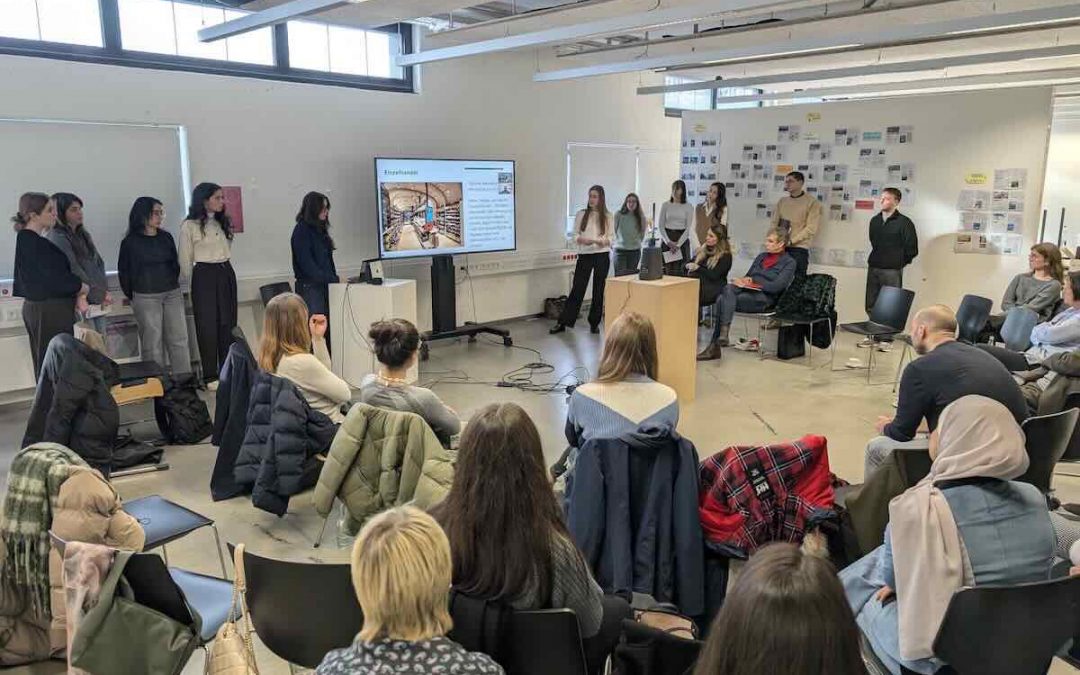
As part of the Re:SET Bürgewald research project, a full-day colloquium took place on December 12, 2025, at the University of Wuppertal. The event was part of the interdisciplinary and cross-university collaboration between TU Darmstadt, the University of Wuppertal, and the Britta and Ulrich Findeisen Foundation for Art and Building Culture.
The aim of the joint day was to deepen the exchange between the participating disciplines, bring together the findings from social, spatial, and economic research conducted to date, and collectively further explore the transformative potential of the Re:SET research house in Bürgewald. In addition to academic discussion, particular emphasis was placed on personal exchange and networking among participants.
Participants and involved actors
The colloquium was attended by students, lecturers, and researchers from various disciplines. Participants included students from the Re:SET seminar at TU Darmstadt as well as students from the programs Economics of Planning and Building and Public Interest Design at the University of Wuppertal. They were accompanied by lecturers from both universities, including Prof. Anett-Maud Joppien, Dipl.-Ing. Albert Dietz, Dipl.-Ing. Karolin Kegel, and M.Sc. Julia Knapp from TU Darmstadt, as well as Prof. Klaus Overmeyer, Prof. i.V. Roland Busch, and M.Sc. Aline Haustein from the University of Wuppertal.
In addition, M.A. Sharon Nathan and M.A. Felix Feldhofer participated as representatives of the Britta and Ulrich Findeisen Foundation for Art and Building Culture, which accompanies the Re:SET project. The professional exchange was further enriched by the social science perspective of M.A. Moritz Fedkenheuer, who joined the event online.
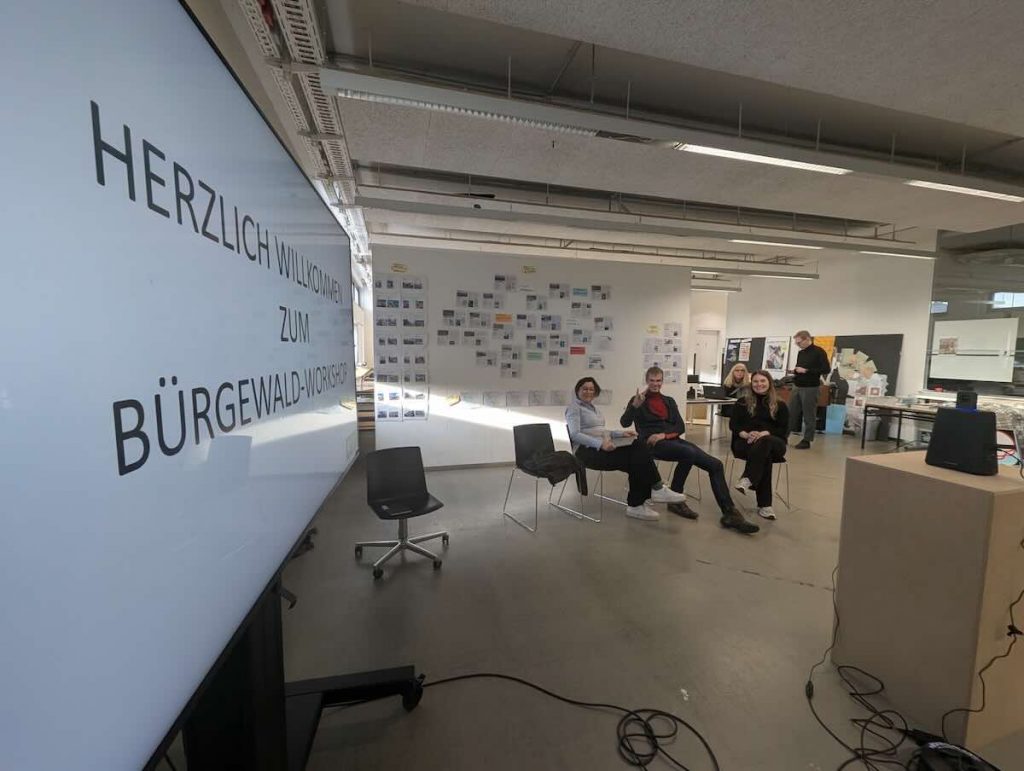
Welcome and introduction to the Bürgewald workshop as part of the Re:SET research project. © Sharon Nathan
Opening and review of Session 1
The research colloquium began with an open and personal introduction that provided space for initial encounters and informal exchange. In a round of introductions, lecturers, researchers, and students came together before short presentations outlined the results achieved so far across the different disciplines. The opening made clear that shared exchange and mutual understanding are central to the ongoing research process.
TU Darmstadt presented its work to date across several strategic fields that link spatial, structural, and societal issues. In addition to analyzing the existing conditions of the research house, particular focus was placed on its potentials and deficits as well as on possible user groups. The goal was to formulate initial strategic building blocks that place people and their needs at the center and serve as a foundation for a viable overall concept for the research project.
The Public Interest Design program presented a so-called village atlas, in which various reference villages were examined comparatively. The analyses focused on each village’s guiding idea, the actors involved, and the village space. In addition, the Economics of Planning and Building program presented further reference locations that were analyzed with regard to village development, village functions, and constellations of actors. Engaging with different rural models led to concrete and inspiring insights that are of particular importance for the further development of the Re:SET research house as a project with collective impact.
In the subsequent discussion, insights from the various levels of analysis were brought together. Particular attention was given to critically reflecting on the planned filling of the Hambach Lake and its possible impacts on the place and its residents. In addition, different models of project development and allocation were discussed in depth. The continuous shift between the scales of building, village, surrounding area, and individual made a significant contribution to a better understanding of the project’s complex social, spatial, and economic interrelationships.
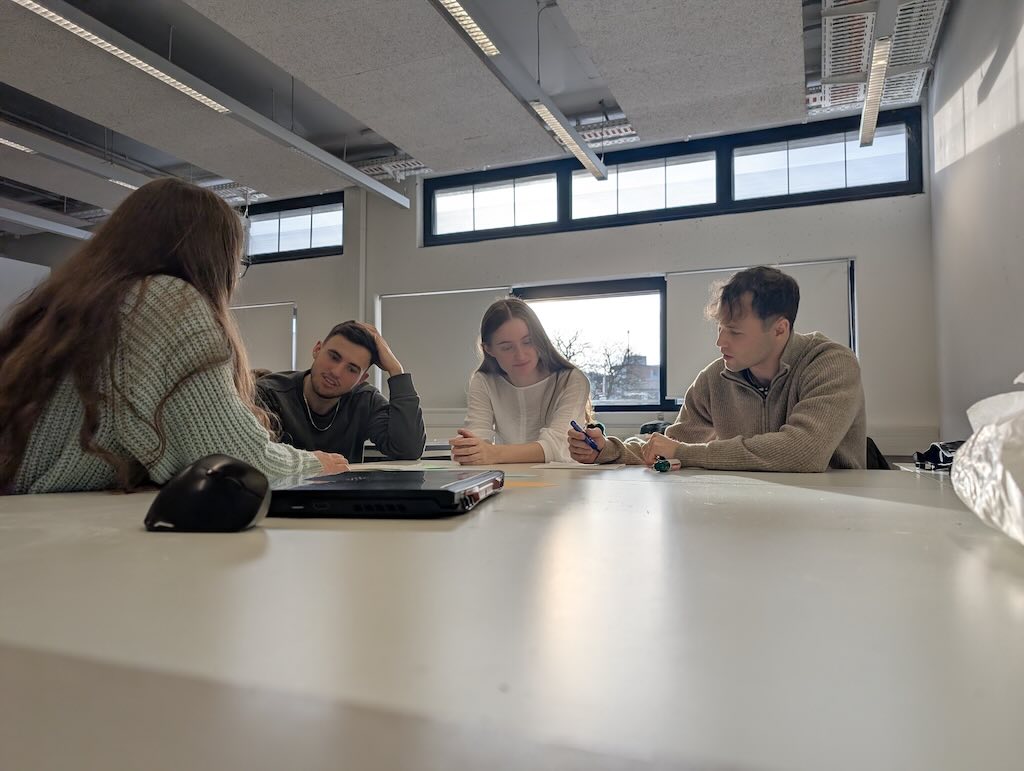
Interdisciplinary group work: students collaboratively develop future scenarios for Bürgewald within the Re:SET project. © Sharon Nathan
Future visions for Bürgewald in Session 2
In the second part of the day, students worked in mixed, interdisciplinary groups to create a shared sketch of life in Bürgewald in the year 2050. Based on this framework, each group first developed an exemplary persona and then created a visionary narrative and depiction of a day in the life of that person. These short stories served as condensed insights into possible social, spatial, and organizational future scenarios for Bürgewald.
Different groups of people served as starting points, including young families, people returning from rural areas, project initiators, business owners and maker types, community-oriented individuals, cultural practitioners, and so-called urban escapees; senior citizens exploring new collective living and housing models; newly arriving migrants and refugees; as well as students or early-career professionals seeking affordable housing. The diversity of these perspectives highlighted the importance of participation, social diversity, and community for Bürgewald’s future.
Conclusion and outlook on Research Phase 02
The collaboration between students from different universities proved to be highly productive and constructive and was characterized by strong motivation. The results were presented in plenary and formed the basis for an open and engaged exchange. The colloquium concluded with an outlook on the upcoming project phases and an agreement to meet again for the final presentation of the second research phase of the Re:SET project.