
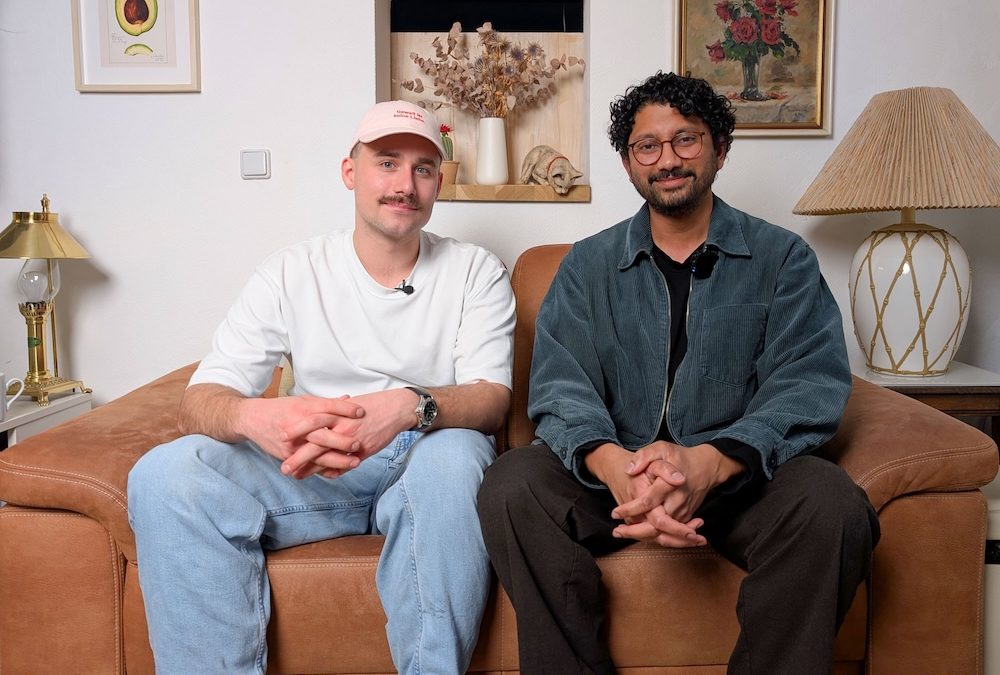
When it comes to discussions about displacement, political catchphrases, statistics, or legal questions around asylum law usually dominate. Much less often is attention paid to another, very tangible aspect: the places where people arrive. Buildings, shelters, and temporary housing forms are a central part of this reality. They shape not only the daily lives of those living there but also society’s perception of migration in Germany.
The Role of Architecture and Urban Planning in Receiving People Seeking Protection
It was precisely at this point that an interview took place between MEP Lukas Sieper (Party of Progress) and art and architectural historian Sharon Nathan on March 6, 2026. For his podcast format, Sieper invited Nathan to a candid conversation designed to offer a different perspective on the topic of displacement. The focus was not on legal or administrative dimensions, but rather on the role that architecture and urban planning play in the reception of people seeking protection.
Sharon Nathan has been working for two years as a research associate at the Britta and Ulrich Findeisen Foundation for Art and Architecture. For about a year, he has also been pursuing a PhD on the history and architecture of refugee accommodations in Germany since 2015. His research thus combines practical work at the foundation with a cultural and architectural perspective on displacement and built environments.

Sharon Nathan, art and architectural historian and research associate at the Britta and Ulrich Findeisen Foundation for Art and Architecture, is pursuing a PhD on the history and architecture of refugee accommodations in Germany. © Sharon Nathan
European Asylum Policy in 2015
The conversation initially focused on the political context of the events around 2015 and the question of how the much-cited “refugee crisis” of that time should be understood. Nathan pointed to a finding often discussed in academic discourse: the challenges of 2015 were less about the absolute number of people arriving and more about the lack of coordination in European asylum policy. In particular, the functioning of the Dublin system meant that individual countries had to organize the bulk of the reception themselves.
„The so-called refugee crisis of 2015 was not a crisis of the refugees. It was a crisis of European administration and solidarity.“
Sharon Nathan, art and architectural historian
At the same time, public perception of the events was heavily shaped by the communication of the numbers. According to the German Federal Ministry of the Interior and Community, around 890,000 people seeking protection were registered in Germany in 2015. By 2016, this number had dropped significantly to about 290,000 registered arrivals. The conversation made it clear that societal perceptions of migration often assumed much higher numbers.
The Influence of Architecture on Integration Processes
From this political level, the conversation shifted to Nathan’s actual field of research: the built environment of arrival. When people arrive, an immediate spatial and architectural question arises: where and how are they accommodated? Nathan explained that various types of refugee accommodations have developed in Germany, such as initial reception centers, collective shelters, or modular housing complexes. Many of these buildings are constructed under significant time pressure. What is initially planned as a temporary solution often remains in use for years in practice.
Sieper was particularly interested in whether architecture itself could influence integration processes. Nathan emphasized that spatial factors indeed play a role. The location of a facility, its integration into existing neighborhoods, and its proximity to infrastructure, employment, and educational institutions can be decisive for how well arrival and social participation succeed.
These questions also form the starting point for Nathan’s current research. In the second year of his PhD, he has begun systematically visiting and documenting accommodations in different regions of Germany. The aim is to examine their architectural concepts, spatial organization, and historical development in more detail.
Designing Spaces as a Long-Term Task for Politics, Planning, and Research
The conversation repeatedly highlighted that asylum-related migration is not a short-term exception. Rather, it is a long-term societal reality to which architecture and urban planning must respond. The design of the spaces where people arrive therefore remains an ongoing responsibility for politics, planning, and research alike.
The full podcast featuring the conversation between Lukas Sieper and Sharon Nathan will be released in the coming weeks. The publication is scheduled for approximately three weeks after the recording and will be available on the digital channels of the Party of Progress. There, the conversation can be listened to in full, with the topics discussed in the interview explored in greater depth.